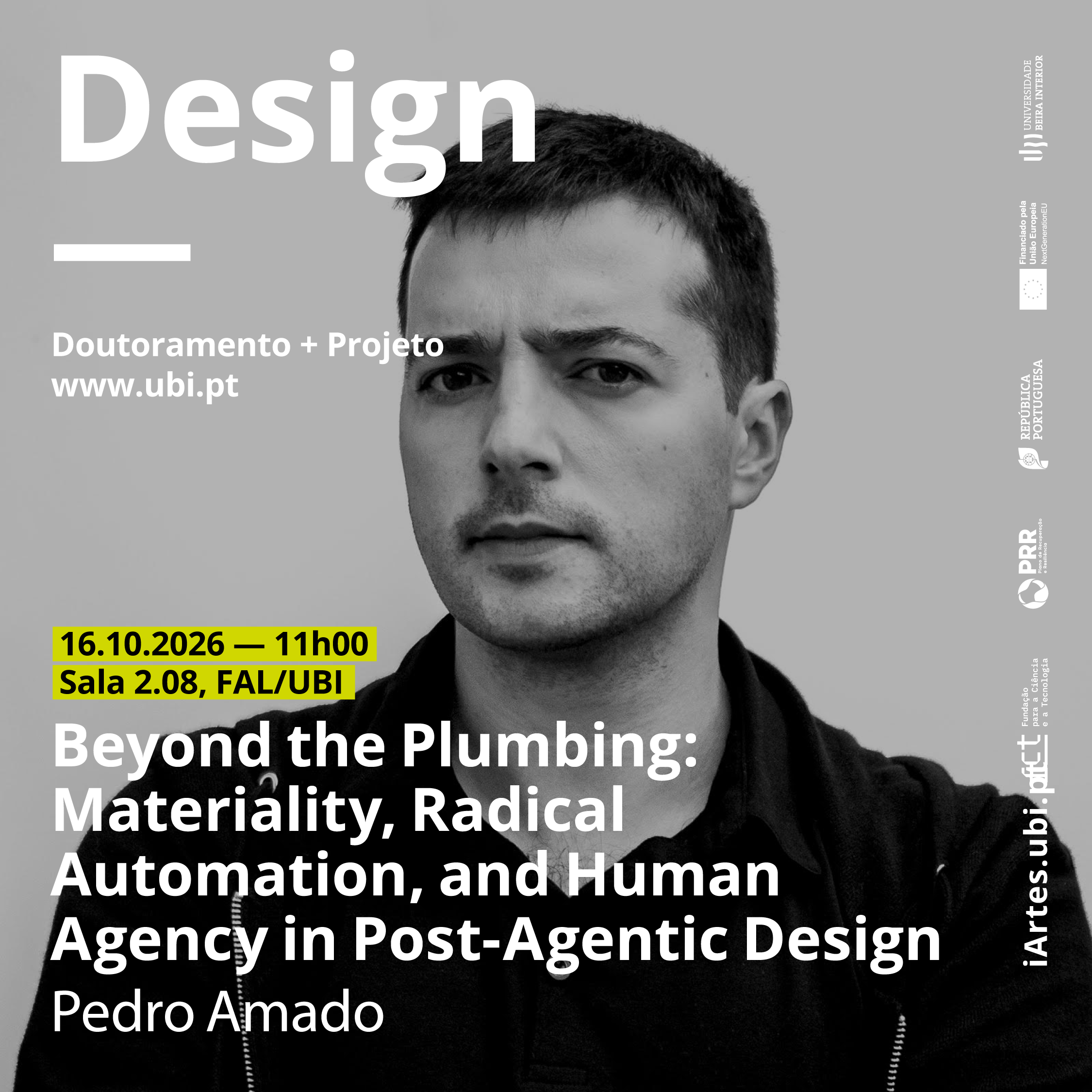
16.10.2026 — 11h00
Beyond the Plumbing: Materiality, Radical Automation, and Human Agency in Post-Agentic Design
Pedro Amado
Sala 2.08, FAL/UBI
Abstract
We stand at the threshold of a structural paradigm shift.
Internationally, design confronts an autocratic, hyper-automated horizon that threatens to erode unmediated human touch and cultural alterity. At the same time, programming and software development routines are ceasing to be commercially viable endeavors—a transition recently epitomized by David Heinemeier Hansson.
Beyond the creative act and programmatic design, almost every task and process of what has traditionally sustained commercial design — classical design as a project-based problem solving activity — and computer programming is mechanical “plumbing”: boilerplate syntax, responsive grid alignment, and component maintenance. With the rise of multimodal Large Language Models, autonomous agent architectures, and open contextual frameworks like the Model Context Protocol (MCP), proprietary software monopolies are losing economic viability as the “browser” and it’s AI-powered agents firmly establish themselves as the new medium for information and interaction.
History offers an illuminating parallel to a previous professional design paradigm-shift: when commercial letterpress printing collapsed in the early-1980s amid the rise of photocomposition and offset lithography, movable type did not perish; it was recontextualized into the deliberate realms of fine press, material research, and cultural heritage. Today, as routine digital production faces the same obsolescence, design research must ask: released from the burden of manual execution, what critical challenges can we finally address?
Reintroducing intentional deceleration, tactile responses, and contemplation — as embodied design strategies — to all products, services and experiences, allows the designer to move beyond the twentieth-century role of software operator and reclaim the mantle of the Post-Agentic Vormgever—a holistic conductor of concepts, data, structures, and materials—driven and realized by radical automation.
Drawing on over fifteen years of practice-based Research-through-Design (RtD), this lecture examines past — to what now seem to have been grounded on prehistoric tools and processes fo deign and development — funded projects across the human lifespan: from participatory ecological reasoning among youth (IMPRINT+), to digital inclusion and social reconnection for older adults (SEDUCE), to open-source provisional printing presses reviving vernacular heritage (PDLP / XT-Press). This trajectory culminates in the SiX Project (2023.11224.PEX), where gaze-operated interfaces, procedural ink dynamics (material exploration of fluid physics), and MCP-driven AI agents act not as human replacements, but as assistive somatic “prosthetics” returning expressive agency, social reconnectivity, and dignity to individuals living with Locked-in Syndrome (LIS) and ALS. Confronting this radical automation, design education must reframe classical, digital, and agentic literacies—grounding advanced current and future research in human emotion, deliberate material resistance, and relational care.
Biography
Pedro Amado, PhD, is an Associate Professor in the Department of Design at the Faculty of Fine Arts of the University of Porto (FBAUP), where he serves on the Scientific Committee and directs the Master’s Degree in Graphic Design and Editorial Projects (MDGPE). He is an integrated researcher and member of the Scientific Board at i2ADS (Research Institute in Art, Design and Society) and a collaborating member of ID+ (Research Institute for Design, Media and Culture). He holds a BA in Communication Design (2002), an MA in Multimedia Art (2007) from FBAUP, and a PhD in Communication Sciences and Technologies from the University of Aveiro (2014).
His practice-led Research-through-Design (RtD) investigates the materialities of typography, processes and outcomes of computational design, the nature and impact of digital materialities, and human-computer interaction design. He has participated in numerous national and European funded R&D projects focusing on provisional instruments and vulnerable demographics across the lifespan: youth ecological literacy (IMPRINT+), digital inclusion for older adults (SEDUCE), smart engineered materials (2SMART), vernacular heritage revival through modular computational letterpress (PDLP and the open-source XT-Press), and intergenerational tacit design preservation (Wisdom Transfer).
He is currently a senior researcher on the FCT-funded project SiX — *Drawing for Social Re-connectivity* (2023.11224.PEX), developing eye-gaze drawing interface prototypes, and AI agentic assistance via Model Context Protocol (MCP) for individuals living with Locked-in Syndrome (LIS) and Amyotrophic Lateral Sclerosis (ALS). Amado is the co-founder of the Portuguese Typography Meetings International conference, on its 16th edition this year (Encontro de Tipografia) and an active advocate for open-source tools and methods—especially in educational settings—, somatic resistance, and epistemic sovereignty and information freedom.